Vintage postcard of The Vagabond Motel in Miami, Florida, with guests lounging around the pool

The Vagabond Motel on a vintage postcard

The Vagabond Motel on a vintage postcard

The Vagabond Motel on a vintage postcard

Where It All Started

Designed by Miami architect B. Robert Swartburg, whose other work included Miami Beach’s Delano Hotel and the Bass Museum, The Vagabond opened in 1953 as a roadside motel at 7301 Biscayne Boulevard, in what is now Miami’s historic MiMo District.

Back then the word motel was a thoroughly modern idea, short for motor + hotel, hence the big MOTEL on our sign. And Biscayne Boulevard was made for it, a stretch of U.S. 1 lined with roadside hangouts and enough neon to make sure nobody drove past unnoticed. (Not to mention naked nymphs... but we’ll explain that later!)

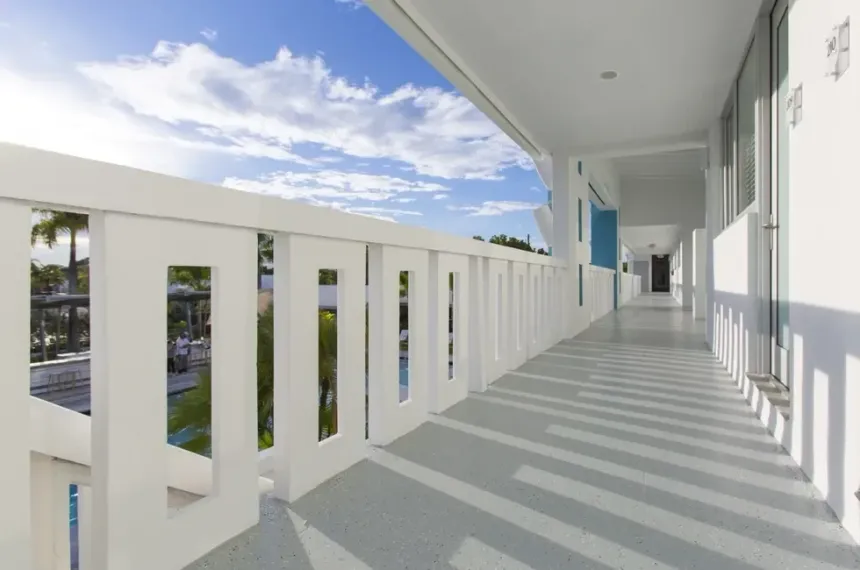
Keen not to be outdone, The Vagabond joined the party with a cocktail lounge and coffee shop of its own, because Swartburg wanted the hotel itself to be part of the attraction. Its style would come to be known as Miami Modern, or MiMo, with bold angles, open-air walkways and playful space-age details made for the tropics and the new automobile age.

Curious about MiMo? Discover the architecture.

The Rat Pack Rumor

Let's be honest, you don't spend more than seven decades on Biscayne Boulevard without picking up a skeleton or two. However, we prefer to call ours stories. And a few of ours come with some pretty famous names attached.

Allegedly, Frank Sinatra, Dean Martin and Sammy Davis Jr. hung out here.

Officially, the history books say the Rat Pack favored a different Vagabond, a club downtown. Unofficially, our guests tell a different story. Over the years, we've had more than a few insist they were here when the Pack was, including one woman who told us she sang backup for the boys during an impromptu performance. And who are we to argue with a firsthand account?

Are we saying it definitely happened? No. But we're not ruling it out either. So, after more than seventy years of hearing the stories, we've learned to conveniently keep an open mind.

After all, where there's smoke...

Vintage 1950s postcard of guests around the pool at the Vagabond Motel on Biscayne Boulevard in Miami
The Vagabond's vintage blue cloud-shaped sign with yellow script lettering

The original cloud-shaped Vagabond sign

The original cloud-shaped Vagabond sign

The original cloud-shaped Vagabond sign

Even Neon Fades

Sadly, nothing stays fashionable forever.

By the late 1960s, the world that had built Biscayne Boulevard was beginning to change. Interstate highways diverted travelers away from U.S. 1. Affordable air travel took off. And the long drive south was no longer the only way to get to Miami.

In a cruel twist of cultural amnesia, the architectural treasures of the MiMo era, once hailed as futuristic beacons of American optimism, became nothing more than dated curiosities. One by one, the roadside motels that had once defined the boulevard began to disappear. Some were demolished. Others were repurposed. Some took a turn for the shady, very Miami Vice shady! Many simply closed their doors.

The Vagabond hung on longer than most, slipping into a slow decline until eventually its doors closed too.

The Fight for MiMo

But not everyone was ready to write off Biscayne Boulevard’s architectural past. Thanks in part to the efforts of preservationists including Teri D’Amico, Randall Robinson, Nancy Liebman and Fran Rollason, Miami’s overlooked mid-century architecture was finally getting the recognition it deserved. The Vagabond was designated a local historic site in 2003, and in 2006 the city established the MiMo Historic District.

The buildings had finally found some protection. Finding someone willing to bring them back to life was another matter entirely.

The Comeback

Then came 2012.

And in walked Avra Jain, a developer, preservationist and something of a real estate renegade.

She didn't flinch at the gutted lobby, the rotting roof, graffiti-tagged walls, mattresses decomposing in the hallways or ransacked rooms littered with abandoned furniture and beer cans. Where others saw a teardown, she saw a MiMo classic hiding in plain sight, and she was far more interested in what it could become than in what it had been reduced to.

Jain assembled a team and got to work. D.B. Lewis led the architectural restoration, with Stephan Dupoux responsible for the interiors. The aim was to preserve the character that had survived and give the rest of the place a future, without turning it into a museum or pretending it was brand new.

In August 2014, The Vagabond reopened as a 42-room independent boutique hotel.

And before the year was out, on December 29, 2014, it was added to the National Register of Historic Places.

The Vagabond Hotel Miami courtyard under restoration, with new pergola frames and palm trees, before its 2014 reopening

The courtyard mid-restoration, before 2014

The courtyard mid-restoration, before 2014

The courtyard mid-restoration, before 2014

Three Nymphs and Dolphins fountain by Juan Stacholy beneath the Vagabond Motel neon sign at The Vagabond Hotel Miami

Juan Stacholy's Three Nymphs and Dolphins

Juan Stacholy's Three Nymphs and Dolphins

Juan Stacholy's Three Nymphs and Dolphins

Original MiMo, Modern Miami

Coming up Biscayne Boulevard, the first thing you’ll spot is the sign. A recreation of the original cloud-and-stars design, it’s the kind of Googie flourish that once fought for every driver’s attention on U.S. 1. And yes, it still says MOTEL, because that’s what it said in 1953, and we weren’t about to argue with history. After dark, the falling-star neon on the side of the building takes over and lights up the boulevard. You can still drive right up and park for free, too. Some things are worth keeping.

Just beyond it, Juan Stacholy’s Three Nymphs and Dolphins sculptural fountain, also known as Fountain of the Gulf, has been holding down the corner since the beginning. Three nude figures frolic in a giant pink clamshell, with water spilling around them and dolphins leaping at their feet. Subtlety was clearly never part of the plan. It was quite the welcome for passing motorists in the 1950s, and more than seventy years later, the ladies are still wearing nothing and attracting plenty of attention. These days they’re not the only ones showing a little skin on the boulevard. Since 2008 they’ve had company across the street, where the Coppertone Girl, Miami’s famous 1959 neon sign, is still having her own wardrobe trouble in public.

Still Doing What It Was Built to Do

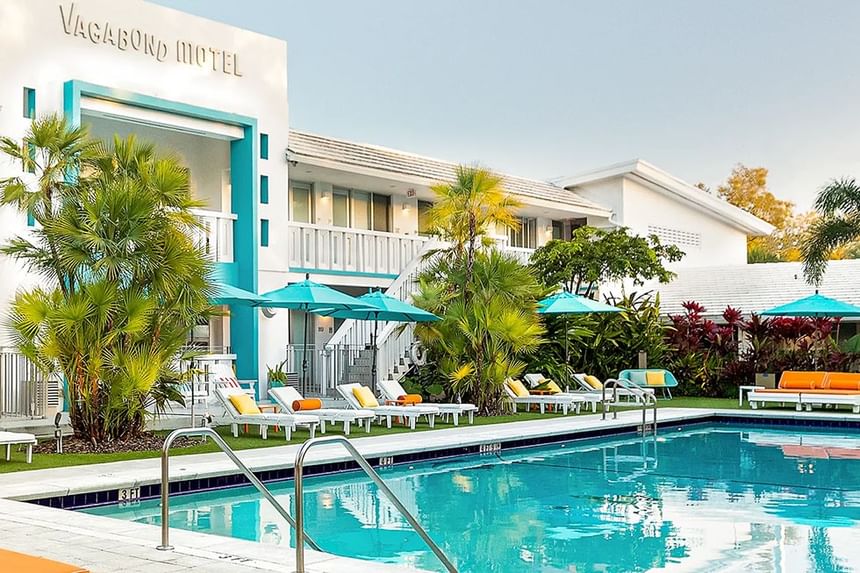
Step inside, and the low-rise buildings wrap around the landscaped courtyard just as they always have, with open-air walkways leading from your door to the pool. There’s color everywhere, from the turquoise pool and mid-century details to the tropical greenery and bright Miami sunshine. It’s a short stroll past the palms, and by day two most guests find themselves taking the long way around.

Waiting at the bottom of the pool is our mosaic mermaid, lovingly restored and still stretched across the floor, with a few fish and dolphins for company. She’s seen a lot of cannonballs in that time and scored every one of them. Nobody’s managed a ten yet. Although, to be fair, she’s a notoriously tough judge.

This isn’t a 1950s set piece. It’s a working hotel that has spent seven decades doing exactly what it was built to do, giving people a reason to pull off the boulevard and stay awhile.

Restored mermaid mosaic on the pool floor at The Vagabond Hotel Miami

Our mosaic mermaid, restored

Our mosaic mermaid, restored

Our mosaic mermaid, restored

Curious what it’s like to stay? Explore our rooms, including our ADA-accessible Catalina King room.

Vintage where it counts. Modern where it matters.